On this page
When it comes to extracting data from industrial nameplates, OCR (Optical Character Recognition) and AI-driven extraction are two popular technologies, but they serve different purposes and excel in different scenarios. Here’s the bottom line:
- OCR: Best for simple, clean, and structured text in predictable layouts. It converts images of text into digital text but lacks contextual understanding. Accuracy drops in challenging conditions like dirt, glare, or non-standard fonts.
- AI-driven extraction: Excels in handling complex, messy, or unconventional nameplates. It understands context, adapts to new formats, and delivers higher accuracy, even in tough environments. However, it requires a higher initial investment.
Quick Overview:
- OCR is faster and cheaper upfront but struggles with noise and lacks flexibility.
- AI-driven systems are more accurate, handle complex layouts, and reduce long-term costs by minimizing errors and manual intervention.
If you’re managing clean, uniform labels, OCR might suffice. But for industrial environments with varied or damaged nameplates, AI-driven systems are the smarter choice.
1. OCR for Nameplate Data Extraction
Technology and Process
OCR works by capturing a digital image of a nameplate using a scanner or camera. Once the image is captured, it goes through a preprocessing phase - a critical cleanup step that can improve recognition accuracy by up to 40%. After that, segmentation takes over, isolating specific text regions, lines, and characters. In industrial applications, “zoning” is often used to focus on key areas like serial numbers.
The text recognition itself relies on two main techniques: pattern matching, which compares character images to stored fonts, and feature extraction, which analyzes elements like lines, loops, and intersections within characters. Finally, post-processing converts the extracted text into machine-readable data. This step includes dictionary lookups and format validation to catch and correct errors. While this process is streamlined for accuracy, its success heavily depends on factors like image quality and text styles.
Accuracy and Performance
Modern OCR systems boast about 95% character accuracy and 92% word accuracy. For high-quality printed documents, traditional OCR can reach 99.2% accuracy, but performance drops significantly with handwritten text or low-quality industrial scans. Contextual analysis during post-processing can enhance word accuracy by 5–10%. When confidence levels fall below 85% for words or 80% for lines, the system typically flags the data for human review.
Despite these advancements, OCR’s performance can falter in challenging environments, such as those found in industrial settings.
Suitability for Specific Scenarios
While OCR technology is powerful, it faces distinct challenges with industrial nameplates. It performs best with clean, structured documents featuring standard fonts and high-contrast layouts. This makes it ideal for processing standard forms, clear labels, and machine-printed text with consistent formatting. However, industrial nameplates often push OCR to its limits. As Heiko Seitz from IDS Imaging Development Systems explains:
“Optical character recognition is still one of the most difficult disciplines in image processing and machine intelligence. The pure variety of possible characters and methods of applying characters to different surfaces gives an idea of the challenges involved.”
Nameplates frequently use text applied through scratching, embossing, or laser engraving, which can distort character shapes and confuse traditional OCR systems. Environmental factors like dirt, metallic reflections, and low-contrast markings further complicate recognition. Additionally, technical information on nameplates is often rotated at 45° or 90° angles, while most OCR engines are optimized for horizontal, left-to-right text. Even clear serial numbers, such as “XV-2001”, can be misinterpreted (e.g., “XV200I”), with accuracy ranging from 81% to 99% depending on imaging conditions.
2. AI-Driven Nameplate Data Extraction
Technology and Process
Traditional OCR often struggles in complex industrial settings, but AI-driven extraction steps in to address these challenges with advanced tools like neural networks, transformer models, and visual language models. These systems go beyond simply identifying characters - they interpret the relationships between different pieces of information, offering a more dynamic approach.
The process operates through a multi-stage pipeline. First, text region detection locates the nameplate and can adjust the camera’s zoom or rotation for better accuracy. Then, segmentation and distortion correction refine the image using sophisticated algorithms. Finally, a dual-model recognition phase integrates both vision and language models to extract meaningful data.
One of AI’s standout features is its ability to adapt to new nameplate formats without requiring manual setup. When faced with ambiguous characters - like distinguishing between “8” and “B” or “0” and “O” - AI evaluates the surrounding context to make the right decision. Automated correction mechanisms further reduce errors by cross-referencing data against expected formats.
Accuracy and Performance
AI-driven extraction delivers impressive results, achieving 95–98% accuracy for standard fields, even in challenging environments. For more complex fields, accuracy ranges between 90–95%. These systems also drastically cut costs; for instance, Lano, a global payroll platform, achieved 99.9% accuracy in document processing after adopting AI, eliminating the need for manual checks.
Unlike traditional OCR, AI systems thrive in tough industrial conditions. They can handle text on curved or reflective surfaces, such as metal cylinders, where conventional OCR methods often fail. Additionally, field-level confidence scoring allows the system to auto-approve highly accurate data (95% or higher), flagging only uncertain entries for human review.
However, there’s a trade-off in speed. While traditional OCR might process a document in under a second, AI pipelines take 5–15 seconds to ensure both structural and contextual accuracy. Despite this, the cost advantage is clear: AI processing costs range from $0.05 to $1.00 per document, compared to $4.00 for template-based OCR and $13.00 for manual entry.
Suitability for Specific Scenarios
AI-driven nameplate extraction is a game-changer for inventory management and spare parts cataloging, where capturing details like voltage, frequency, power requirements, and manufacture dates is critical. This ensures replacement parts are perfectly suited to the original equipment.
For instance, Bureau Veritas implemented AI-powered extraction in 2021, saving $9 million annually by reducing customer churn and speeding up data processing for inspectors. Similarly, Nexi Group automated their paper documentation workflows, saving 400 hours per month.
In real-world settings like warehouses and factories, where lighting is poor or nameplates are dirty and rotated at odd angles, AI systems still perform effectively. They can extract data from less-than-perfect images and output structured data in JSON format, ready to integrate into ERP systems. This eliminates the need for additional processing, making these solutions practical for organizations dealing with varied layouts, unconventional fonts, or damaged labels. AI-driven extraction provides the adaptability and precision that traditional OCR simply cannot match.
Pros and Cons
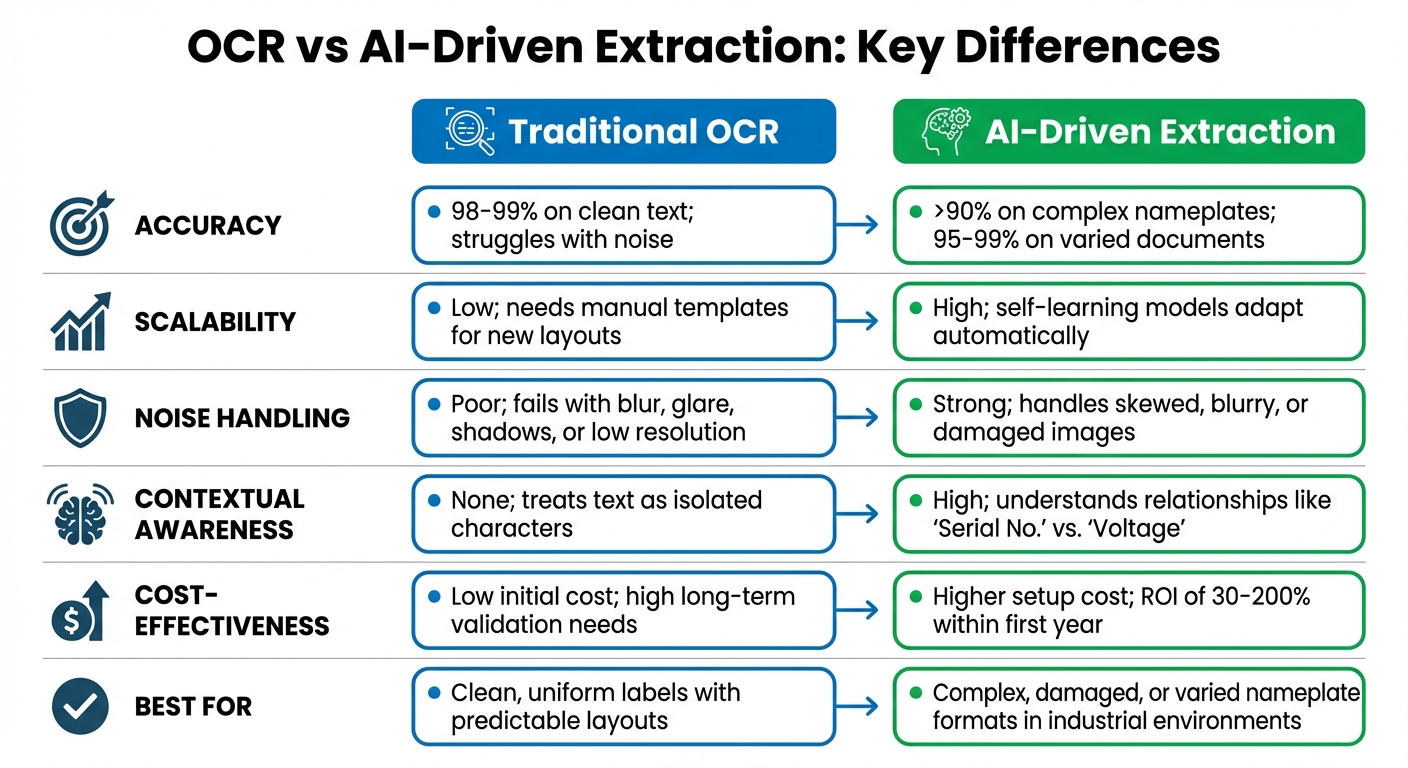
Let’s take a closer look at how the two technologies stack up in extracting nameplate data. Each method has its own strengths and challenges, making them suitable for different use cases.
Traditional OCR shines when dealing with clean, high-contrast text in predictable layouts. Think of internal warehouse labels or shipping documents from a single vendor with a fixed format. It achieves impressive accuracy - between 98% and 99% - on pristine, printed text while keeping upfront costs relatively low. However, its lack of contextual understanding can lead to errors that ripple through downstream systems, creating bigger data quality issues over time.
On the other hand, AI-driven extraction handles complexity with ease. It maintains over 90% accuracy even on tricky nameplates - those with curved metal surfaces, glare, dirt, or unusual fonts. Its adaptability to new formats without manual programming makes it ideal for scaling operations. Additionally, AI-driven systems can slash processing times by 73% and reduce operational costs by as much as 97%. The trade-off? A higher initial investment compared to traditional OCR.
Here’s a quick comparison to break it down further:
| Feature | Traditional OCR | AI-Driven Extraction |
|---|---|---|
| Accuracy | 98–99% on clean text; struggles with noise | >90% on complex nameplates; 95–99% on varied documents |
| Scalability | Low; needs manual templates for new layouts | High; self-learning models adapt automatically |
| Noise Handling | Poor; fails with blur, glare, shadows, or low resolution | Strong; handles skewed, blurry, or damaged images |
| Contextual Awareness | None; treats text as isolated characters | High; understands relationships like “Serial No.” vs. “Voltage” |
| Cost-Effectiveness | Low initial cost; high long-term validation needs | Higher setup cost; rapid ROI of 30–200% within the first year |
These differences are particularly relevant when tackling spare parts cataloging in industrial environments. AI-enhanced OCR can dramatically reduce manual data entry errors - by up to 90% - and cut labor costs by 80%. For industries dealing with equipment from hundreds of manufacturers, where the variety of nameplate formats is seemingly endless, AI eliminates the constant need to create and update templates for every new format. This makes it a game-changer for managing complex data efficiently.
Conclusion
Deciding between traditional OCR and AI-driven extraction boils down to your specific operational requirements. If you’re dealing with thousands of identical, clean nameplates with fixed layouts - like internal warehouse labels or standardized shipping documents - traditional OCR can deliver fast and cost-efficient results.
But let’s face it, most industrial environments are far from pristine. Nameplates are often mounted on curved metal surfaces, covered in dirt, exposed to poor lighting, and come in a variety of formats. This is where AI-driven systems shine. As Niels Tonsen, Co-founder & CEO of Turian, puts it:
“OCR is one component (the initial eye that sees the text) and AI is the brain that comprehends and executes on it”.
That ability to comprehend is critical, especially when distinguishing a serial number from a voltage rating or processing a blurry smartphone photo taken in a chaotic shop floor setting. This deeper understanding ensures more accurate inventory tracking and maintenance operations.
For projects that are time-sensitive or smaller in scale, AI has a clear edge. It eliminates the need for creating templates or manual programming, saving valuable time. In fact, one large-scale industrial inventory implementation achieved over 90% accuracy, drastically reducing manual data entry. Beyond efficiency, the financial benefits of AI-driven systems make a strong case for their adoption.
From a financial perspective, AI offers impressive returns. While the initial investment is higher, many companies report ROIs ranging from 30% to 200% within the first year. The VisionParser team highlighted:
“the lower accuracy of traditional OCR creates 3-5x higher manual review costs, which more than offsets the AI API price difference”.
These financial gains underscore AI’s impact on reducing labor costs and minimizing downtime. In complex industrial environments, the technology often pays for itself quickly.
For a balanced approach, combining OCR for raw text capture with AI for contextual interpretation provides a scalable solution that evolves with your operational demands.
FAQs
When should I choose OCR over AI for nameplates?
When scanning printed labels on flat, consistent surfaces, OCR (Optical Character Recognition) is the ideal choice. It delivers clear, reliable results for straightforward layouts where traditional pattern recognition methods work well.
On the other hand, AI-based solutions shine in more complex situations. Think of scenarios like extracting text from curved metal surfaces, glossy packaging, or even handwritten notes. AI is built to handle challenges such as distortions, poor lighting, and varied formats, reducing the need for manual adjustments and ensuring higher accuracy.
In short, OCR is best for simple, predictable tasks, while AI is your go-to for tackling difficult nameplate data extraction or other intricate cases.
How much training data does AI need to read my nameplates well?
AI systems typically need a large volume of training data - ranging from thousands to tens of thousands of labeled examples - to effectively interpret nameplates. This extensive dataset is crucial for preparing the system to handle diverse challenges, such as different fonts, inconsistent lighting, and wear and tear on the nameplates.
What image quality do I need for reliable nameplate extraction?
For dependable nameplate extraction, ensure your image resolution is at least 300 DPI. To improve clarity and detail - particularly for intricate or poor-quality images - apply preprocessing methods like deskewing, denoising, and binarization. These techniques play a key role in capturing data from nameplates with precision.