On this page
Inventory intake issues can cost businesses time, money, and efficiency. Here’s what you need to know:
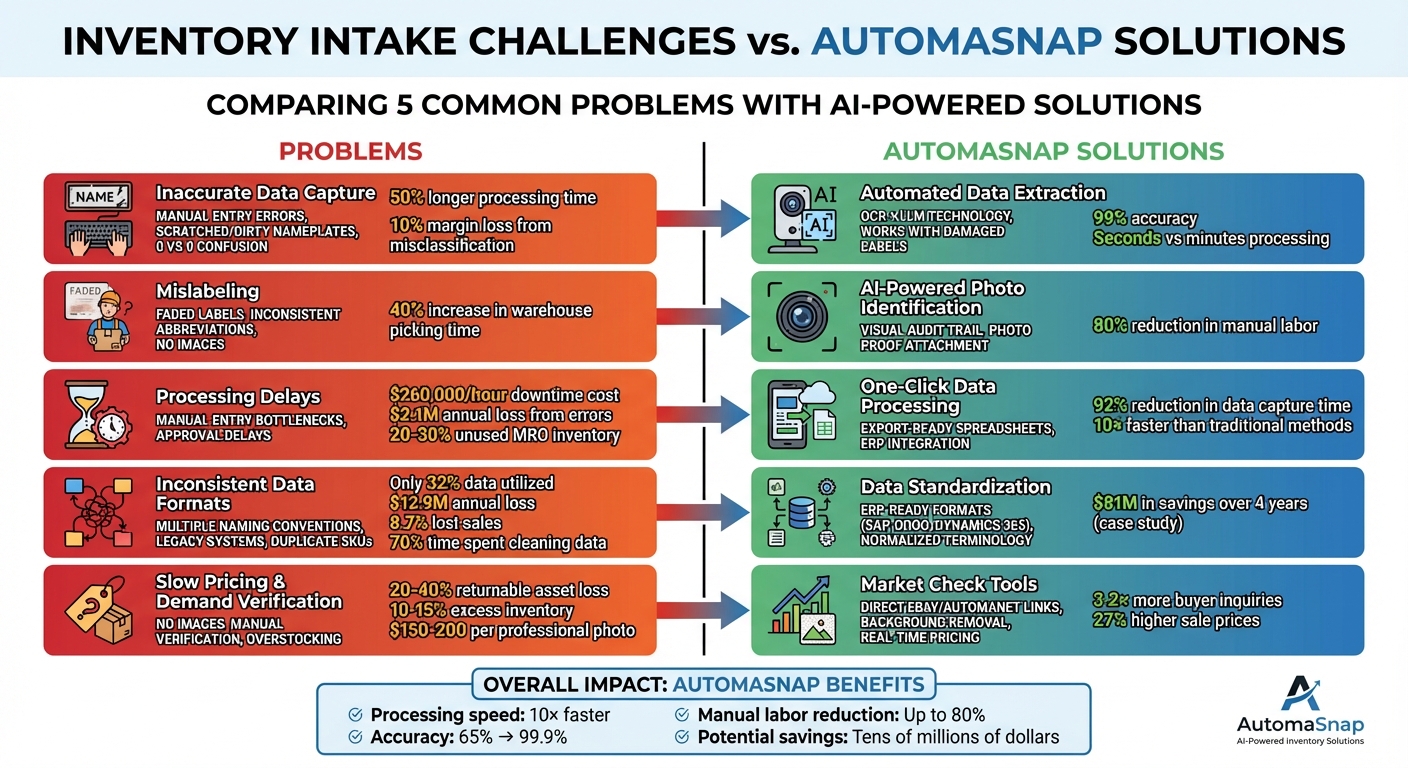
- Problem 1: Inaccurate Data Capture
Manual entry from worn or dirty nameplates leads to errors, delays, and costly mistakes. - Problem 2: Mislabeling
Faded or inconsistent labels result in duplicate SKUs, wasted time, and misorders. - Problem 3: Processing Delays
Manual data entry slows operations, with errors costing manufacturers millions annually. - Problem 4: Inconsistent Data Formats
Different naming conventions across systems create silos and inefficiencies. - Problem 5: Slow Pricing and Demand Verification
Outdated methods lead to overstocking, missed sales, and inflated costs.
Solution: AutomaSnap
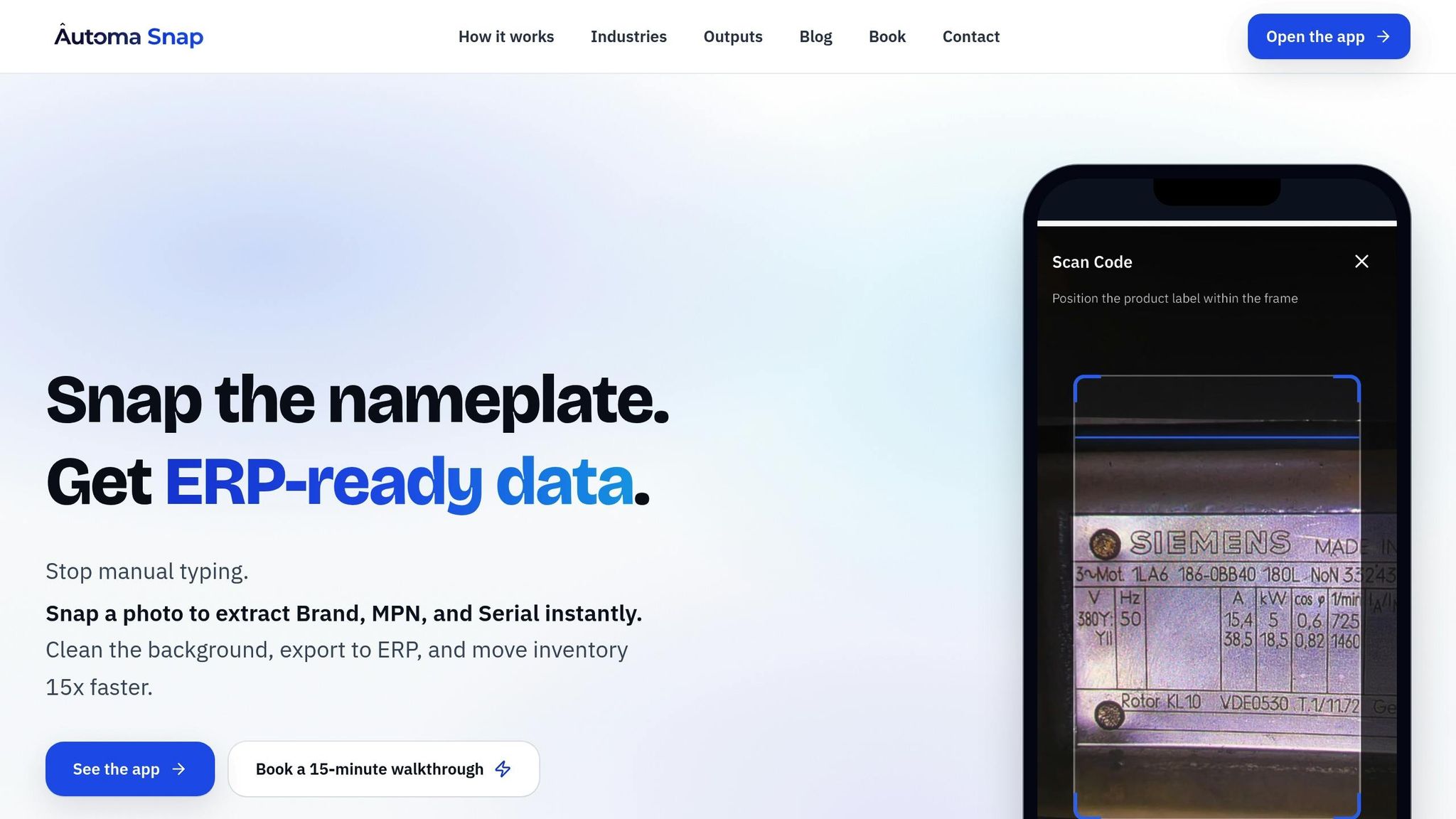
This AI-powered tool tackles these challenges by automating data extraction, standardizing formats, and enabling instant market checks. It improves accuracy, speeds up processes, and reduces manual labor by up to 80%, saving businesses time and money.
Problem 1: Inaccurate Data Capture from Nameplates
At warehouse docks, workers often have to manually input spare parts data from nameplates into spreadsheets. This process is not only slow but also prone to errors. A single mistake during data entry can trigger a chain reaction - incorrect orders, delayed repairs, and costly downtime. These errors don’t just inconvenience operations; they inflate costs across the board.
The situation is made worse by the condition of nameplates. They’re frequently scratched, covered in grime, or poorly lit, making details hard to decipher. Workers are left trying to distinguish between similar-looking characters, like “0” and “O”, turning the task into a frustrating guessing game.
“Without barcodes, spare parts warehouse workers are forced into a guessing game that’s tedious and mistake-prone.”
- Ashley Taylor, Product Manager, Cleverence
Inconsistencies in naming conventions add another layer of complexity. Duplicate SKUs creep into inventory, unnecessarily tying up capital and bloating stock levels. Financially, the impact is clear: manually processed items take 50% longer to handle, and misclassification can cut margins by up to 10%.
AutomaSnap Solution: Automated Data Extraction from Nameplates
AutomaSnap addresses these issues by eliminating the need for guesswork. With this tool, workers can photograph nameplates, and the system automatically extracts structured data like Brand, MPN, Serial Number, and technical specifications - even from damaged or dirty labels. Using advanced AI powered by Optical Character Recognition (OCR) and Large Language Models (LLMs), AutomaSnap overcomes challenges like scratches, poor lighting, motion blur, and awkward camera angles.
What sets this system apart is its ability to understand context. For example, it knows that “Siem 6ES7…” and “Siemens 6ES7…” refer to the same manufacturer. By cross-referencing the extracted data with OEM catalogs, it validates part numbers and fills in any missing details. If the system encounters ambiguous matches or low-confidence results, it flags them for quick human review, achieving nearly 99% accuracy. Once validated, AutomaSnap generates ERP-ready spreadsheets from smartphone images, cutting processing time from minutes to just seconds.
Problem 2: Mislabeling and Identification Errors
Mislabeling makes it incredibly difficult to identify parts accurately. Imagine flipping through a catalog filled with rows of identical titles - 100 valves, 100 gaskets, 100 connectors - and not a single image to distinguish them. Workers are left to rely solely on text descriptions, a nearly impossible task when the parts look exactly the same.
This problem becomes even worse when labels are faded, greasy, or damaged, especially in poor lighting conditions or shadowed areas. On top of that, inconsistent abbreviations - like using “HP” in one record and “hp” in another for horsepower - create mismatches across systems. This kind of “dirty data” not only slows down the intake process but also compromises the accuracy of future reports.
“Whenever we review the spare parts catalogues of new customers, we see the same story. Page after page, most parts have no images. There are rows of identical titles, 100 ‘valves,’ 100 ‘gaskets,’ 100 ‘panels,’ 100 ‘connectors,’ and not a single picture to tell them apart.”
Misclassification doesn’t just waste time; it eats into profit margins. Without standardized labels, warehouse picking times can increase by as much as 40%. Even a simple typo in a model number can lead to ordering the wrong replacement part during a critical breakdown, causing costly delays. These errors not only slow down operations but also drive up expenses, making it clear that a smarter, AI-driven solution is needed.
AutomaSnap Solution: AI-Powered Photo Identification
AutomaSnap tackles mislabeling head-on by using AI to identify parts directly from photos. The system combines visual recognition with OCR (optical character recognition) to extract key details like make, model, and serial numbers - even if the nameplates are partially obscured or handwritten. Its deep learning models can pick up on subtle differences in logos and textures that often go unnoticed by the human eye.
One standout benefit of this approach is the creation of a visual audit trail. AutomaSnap attaches photo proof to each item record, allowing technicians to quickly verify AI-extracted data instead of manually entering it. This reduces manual labor by up to 80%. For example, in January 2026, a large industrial plant using AI for asset creation cut total setup time by 70% and eliminated typing errors on 16-digit serial numbers.
The system is designed to work seamlessly with shop-floor photos taken on smartphones, so no additional hardware or process changes are required. Even when dealing with dirty or scratched nameplates, the AI can still extract accurate data. For the best results, wiping off dust or grease before taking a photo significantly boosts accuracy. By attaching photo proof to each record, AutomaSnap simplifies inventory verification and reduces costly errors.
Problem 3: Delays in Processing Spare Parts
Manual data entry is a major hurdle when it comes to processing spare parts. Every part’s information has to be typed in manually, which not only takes extra time but also increases the likelihood of errors. The situation worsens when parts arrive without barcodes or serial numbers. Workers are left to estimate details, which often leads to mistakes. On average, manual processing takes about 50% longer than using AI-driven systems.
“Manual data entry is one of the biggest culprits for slow receiving. Each part’s information has to be typed in by hand, eating up time and raising the chance of mistakes.”
- Ashley Taylor, Product Manager, Cleverence
These delays don’t just stop at the receiving dock - they ripple throughout the supply chain. Maintenance teams are left with outdated inventory records, making it harder to plan and execute repairs. The financial impact is staggering: unplanned downtime in industrial manufacturing can cost up to $260,000 per hour. Manual approval workflows only make things worse, turning what should be a quick process into a drawn-out cycle that can last weeks.
The financial toll doesn’t stop there. Reporting delays and manual entry errors cost manufacturers an average of $2.1 million annually due to rework, excess inventory, and missed delivery deadlines. Additionally, poor tracking leads to inefficiencies, with 20–30% of MRO inventory items going unused. Without accurate, timely stock verification, teams risk ordering duplicate parts or paying a premium for emergency shipments. Clearly, solving these delays is essential, and AI-driven solutions offer a practical way forward.
AutomaSnap Solution: One-Click Data Processing
AutomaSnap eliminates manual entry by turning smartphone photos into structured, export-ready spreadsheets. Just point your camera at a nameplate, snap a photo, and the AI extracts critical details - such as brand, model, and serial number - even from partially obscured or handwritten labels. These details are then organized into spreadsheets compatible with systems like SAP, Odoo, Dynamics 365, and BaseLinker.
The impact on processing speed is impressive. For example, in March 2025, Landsec, a real estate firm, adopted AI-driven procurement software to manage maintenance and intake data. This reduced their manual data capture and validation time by 92%, significantly improving productivity. AutomaSnap offers the same benefits - intake data is captured instantly using just a web browser and smartphone camera, with no need for extra tools or workflow changes. Plus, AI photo recognition can cut manual labor in inventory processes by up to 80%, allowing your team to focus on more valuable tasks instead of tedious data entry.
Problem 4: Inconsistent Data Formats Across Systems
Delays in processing spare parts often reveal a deeper issue: inconsistent data formats across systems. Inventory data comes from a mix of legacy databases, spreadsheets, invoices, and modern apps, but rarely do these sources share a common format. For instance, one department might record a part as “SS FLANGE 3IN”, while another lists it as “Flange, Stainless Steel, 3 inch.” These variations create data silos, making it nearly impossible to get a complete and accurate view of your inventory. The problem becomes even more pronounced after mergers or acquisitions, where legacy systems bring entirely different naming conventions for the same suppliers and parts. This lack of consistency doesn’t just make record keeping a headache - it directly impacts the bottom line.
The numbers are telling. Only 32% of available data is effectively utilized, leading to an average annual loss of $12.9 million and 8.7% in lost sales. Without a unified data standard, departments end up creating their own identifiers, units of measure, and attribute formats, which only adds to the complexity of managing inventory.
“Supply chains don’t fail from a lack of data - they fail due to unstandardized data.”
The operational fallout is just as severe. Data scientists and materials managers spend a staggering 70% of their time cleaning and organizing data, leaving only 30% for strategic tasks. Despite the clear need for standardization, only 54% of manufacturers have implemented a unified data standard. This lack of alignment leads to issues like duplicate SKUs, errors in automated processes, and reconciliation gaps.
AutomaSnap Solution: Data Standardization for ERP Systems
AutomaSnap directly addresses these inconsistencies by standardizing data into formats that align seamlessly with your ERP system. When you scan a nameplate, the AI doesn’t just extract text - it understands the meaning behind it. For example, it identifies that “SS FLANGE 3IN” and “Flange, Stainless Steel, 3 inch” are the same item. The system normalizes part numbers, converts units to your company’s standards, and unifies terminology across all data sources.
The standardized data is exported in machine-readable formats like CSV or JSON, which can sync directly with ERP systems such as SAP, Odoo, Dynamics 365, and BaseLinker. This ensures real-time inventory updates without the need for manual reconciliation. A great example comes from 2024, when a major North American oil refining company used AI-driven standardization across 20 plants to address fragmented MRO data. By identifying duplicate materials across multiple ERP and CMMS platforms - without destructive data cleansing - they uncovered $10 million in savings from duplicate consolidation and $81 million in total savings opportunities over four years. AutomaSnap offers the same level of precision, turning disorganized data into clean, reliable records your ERP system can trust.
Problem 5: Slow Verification of Pricing and Demand
When it comes to inventory management, time is money. Without a quick way to verify market pricing or assess demand, you risk stocking products that no longer align with market needs or undervaluing items that could fetch higher prices. The fallout? Overstocked shelves, inflated working capital, and missed sales opportunities. These inefficiencies not only drive up operational costs but also slow your ability to respond to market changes.
But the problem isn’t just about speed. Many spare parts catalogs don’t include images, leaving staff to rely solely on text descriptions. This makes distinguishing between similar items a frustrating and error-prone process. Professional photography, while helpful, is expensive - typically costing $150 to $200 per item. For most businesses, photographing every part isn’t financially feasible.
The financial toll is hard to ignore. Companies lose 20–40% of their returnable assets each year due to poor tracking and verification processes. Additionally, maintenance, repair, and operations (MRO) teams often hold 10–15% more inventory than necessary because inaccurate data obscures what’s actually available in stock. Without clear visibility across locations, teams may resort to rogue purchases to secure critical parts, further inflating inventory levels.
“In the B2B world, particularly in the technical domain of spare parts aftersales, buying decisions are purely rational and transactional… images are required to eliminate risk.”
- nyris
Manual verification methods, like phone calls or spreadsheets, are not just slow - they’re prone to errors. These outdated processes limit teams to checking only a handful of items each day, leaving hundreds untouched.
AutomaSnap Solution: Market Check Tools and Image Optimization
AutomaSnap tackles these challenges head-on, making it easier to align inventory with market realities. With direct search links to platforms like eBay and Automanet, you can instantly verify market prices and review sold listings straight from your scanned data. A simple scan of a nameplate provides access to real-time pricing insights, grounded in actual marketplace data - not guesswork. Sellers leveraging AI-assisted listing tools report 3.2× more buyer inquiries and a 27% increase in average sale price, thanks to accurate descriptions and competitive pricing.
The platform also simplifies image management with one-click background removal, transforming shop-floor photos into clean, professional visuals. Even items with weathered labels can be turned into sales-ready images in seconds. These high-quality visuals help reduce misorders by enabling buyers and technicians to visually confirm parts, which in turn lowers return rates and prevents the buildup of unsellable inventory.
AutomaSnap also includes a photo proof attachment feature, ensuring every inventory item has a visual record. This makes it easier to verify an item’s condition and authenticity, speeding up demand verification and improving sales readiness. Whether you’re listing items on eBay, updating your ERP system, or responding to customer inquiries, AutomaSnap equips you with the tools to stay ahead.
Conclusion
Inventory intake doesn’t have to slow you down. The challenges it presents - lost time, higher costs, and operational blind spots - can quietly pile up. Manual processes that once felt manageable now sap resources, with data entry taking 50% longer than automated systems and errors like misclassification cutting profit margins by as much as 10%.
AutomaSnap’s AI-powered solution addresses these problems head-on. By automating data extraction from nameplates, standardizing formats across ERP systems, and enabling instant market checks, the platform eliminates inefficiencies at their source. Automated scanning operates 10× faster than traditional counting methods, freeing your team to focus on more impactful, strategic tasks instead of repetitive data entry.
The benefits go beyond efficiency. Companies adopting AI for inventory unification have uncovered savings in the tens of millions of dollars. For example, one refining company identified $81 million in potential savings over four years. Accuracy improvements from 65% to 99.9% lead to fewer stockouts, improved cash flow, and faster response times.
“Treating spare parts master data as a strategic asset isn’t optional - it’s the new standard in industrial excellence.”
- Philipp Begala, Partium
FAQs
What photo quality does AutomaSnap need to read dirty or damaged nameplates?
AutomaSnap works best with high-quality, clear, and well-lit photos, especially when dealing with dirty or damaged nameplates. Good lighting and sharp focus are essential for the AI to accurately interpret both images and text.
How does AutomaSnap prevent duplicate SKUs and inconsistent part descriptions?
AutomaSnap leverages advanced AI to tackle data issues like duplicate SKUs and inconsistent part descriptions. By analyzing multiple data sources, it detects duplicates - even when descriptions vary - and merges them into one accurate record. It also brings consistency to part descriptions by aligning them with recognized industry taxonomies. This approach addresses challenges such as fragmented data, inconsistent naming conventions, and mistakes from manual entries.
What does it take to export AutomaSnap data into my ERP?
To export AutomaSnap data to your ERP, start by using the SNAP export feature to generate a CSV file that’s compatible with your ERP system. Make sure the columns in the file align with your ERP’s required format and headers. Once the file is ready, upload it through your ERP’s import tool. During this step, map the headers correctly and double-check that the data types are accurate.
For a smoother workflow and to save time, you might want to automate this process. Automation can help ensure consistent data formatting and cut down on repetitive manual tasks.