On this page
When spare parts intake is slow, it leads to downtime, higher costs, and inefficiencies. Here’s how AI-powered tools can help you save time, reduce errors, and streamline your process:
- AI Nameplate Data Extraction: Quickly digitize equipment details from photos, cutting manual entry time by 80%.
- Automated Image Processing: Clean up and standardize photos in seconds for better cataloging.
- Real-Time Data Integration: Sync inventory with work orders to avoid duplicates and improve visibility.
- Automated Purchase Orders: Generate orders based on stock levels to prevent shortages.
- Predictive Analytics: Forecast demand to optimize inventory and reduce excess stock.
- Approval Workflow Automation: Use decision rules to speed up validation and flag exceptions.
- Market Checks and Supplier Verification: Match parts with OEM catalogs to avoid duplicates and find better pricing.
AI tools can reduce manual effort, improve accuracy, and save money by addressing inefficiencies in spare parts management. For example, companies have reported cutting operational costs by up to 97% and reducing inventory by 15–30% within months of implementation.
1. Use AI-Powered Nameplate Data Extraction
Automation and AI Integration
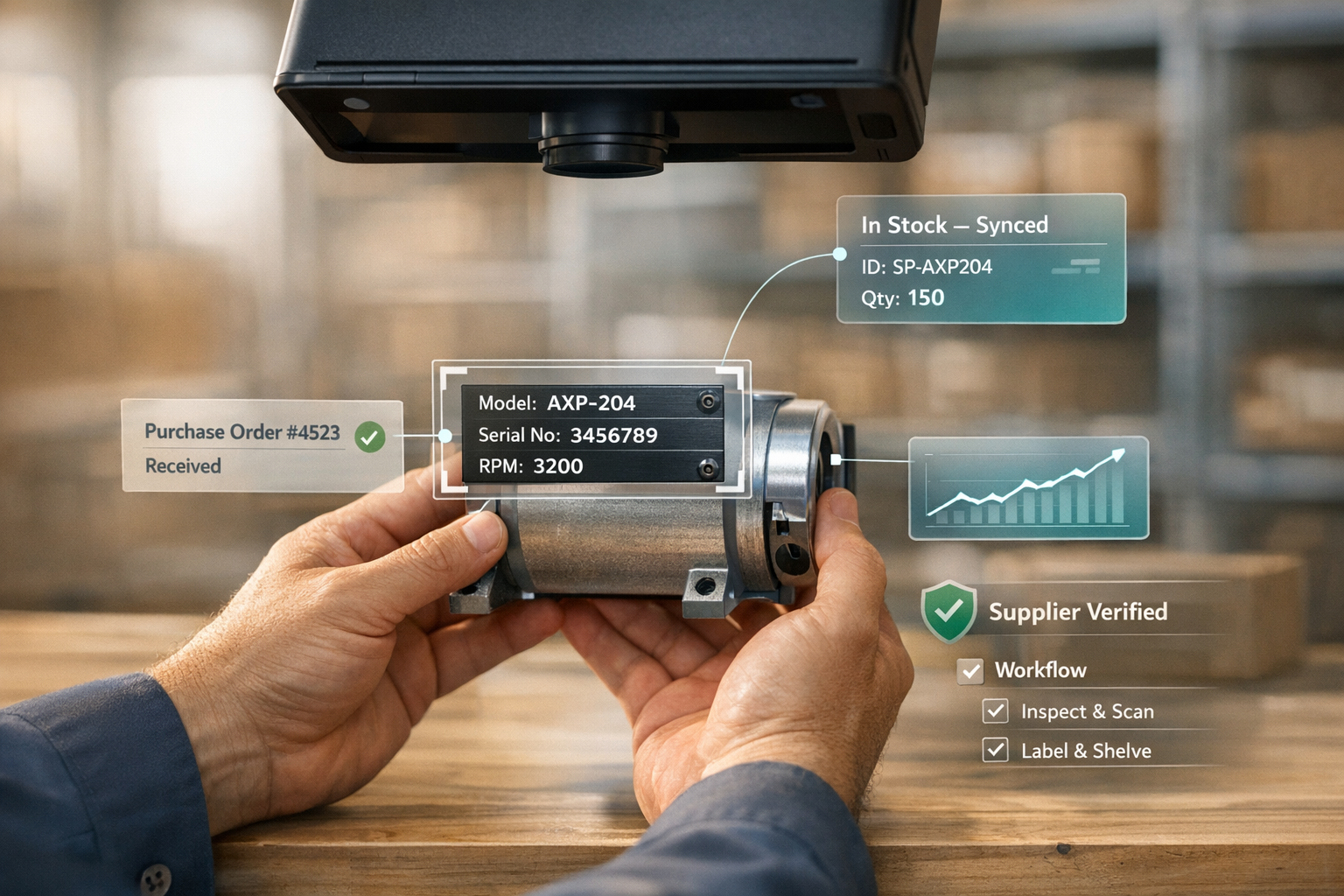
Manually entering nameplate data is time-consuming and prone to mistakes. AI-powered tools like AutomaSnap solve this by transforming a simple smartphone photo into a structured, accurate record in just seconds. Using OCR (Optical Character Recognition) and image recognition, these tools extract key details such as manufacturer names, model numbers, serial numbers, and technical specs - even when labels are worn or damaged.
Modern AI systems are designed to handle technical jargon and manufacturer-specific codes with ease. For instance, they can identify that “TI GRADE 5” and “Titanium” mean the same material. Plus, they work with unstructured data sources like blurry photos, CAD files, and PDFs. This automated process not only speeds up data capture but also reduces the errors that often come with manual entry.
Reducing Errors
Mistakes like a typo in a 16-digit serial number can have serious consequences, such as ordering the wrong part. AI mitigates this risk by standardizing naming conventions and eliminating duplicate entries. For example, it recognizes that “HP”, “hp”, and “horsepower” are equivalent terms. It also flags duplicate records that might slip through traditional ERP systems, helping organizations save both time and money by improving data accuracy.
“The path to smarter sourcing and faster transformation starts with clean parts data - and AI agents are the fastest way to get there.”
— Sumit Sinha, CTO & Co-Founder at Kavida.ai
Faster Intake Process
The time savings from AI-powered extraction are game-changing. Instead of taking weeks or months, legacy asset onboarding can now be completed in just days or even hours. Many organizations report cutting turnaround times by over 60% and reducing operational costs by as much as 97%. With accuracy rates exceeding 90%, any ambiguous data is quickly reviewed and resolved through a human-in-the-loop process. This efficiency directly reduces production downtime and improves inventory management.
“AI doesn’t just cut setup time; it ensures those minutes are spent building a foundation for long-term reliability.”
— Alexandra Vazquez from CMMS
Easy Integration with Existing Systems
AI tools like AutomaSnap don’t just enhance speed and accuracy - they also integrate smoothly with existing systems. The process is simple: technicians take a photo, the AI extracts the data, a human verifies it, and the system links the asset using a QR code.
To get the best results, clean nameplates before taking photos and use extra lighting in dim environments. Many companies start with a 30-day pilot program, testing 50–100 high-friction parts. Within 60–90 days, they often see measurable improvements in efficiency and accuracy.
2. Automate Background Removal and Image Processing
Automation and AI Integration
Warehouse photos often come with challenges like shadows, clutter, and poor lighting. AI-powered tools step in to tackle these issues, transforming raw snapshots into clean, catalog-ready images. Using convolutional neural networks (CNNs) trained on massive image datasets, these systems efficiently isolate spare parts and place them against a pure white background (#ffffff). Advanced techniques like semantic segmentation combined with alpha matting ensure smooth edge detection, even for intricate items like mesh filters or glass components. This level of precision not only improves the images but also streamlines the inventory intake process.
Impact on Intake Speed
Enhanced imaging doesn’t just look better - it works faster. AI-driven tools can process up to 50 images in just 3–5 minutes, compared to the 12–25 hours it might take manually. In some cases, individual images are processed in as little as 30 seconds, which is a game-changer for divisions handling thousands of SKUs. As MindStudio highlights:
“What used to take 15-30 minutes per image in Photoshop now happens in seconds with AI models.”
With one-click background removal, teams can instantly generate polished images ready for ERP workflows, saving significant time and effort.
Error Reduction Capabilities
Speeding up image processing also means boosting accuracy. Poor-quality images often lead to misidentifications and duplicate records - research indicates that inconsistent visuals can cause up to 30% duplicate parts. By standardizing images, automated systems reduce these errors and enhance the performance of visual search tools. For example, Optical Character Recognition (OCR) technology can extract part and serial numbers directly from clear, high-quality photos. This combination of speed and accuracy is essential for improving inventory intake and cutting down on costly mistakes.
3. Connect Real-Time Inventory Data With Work Order Systems
Automation and AI Integration
Real-time data connectivity takes spare parts management to the next level by streamlining processes even further. AI platforms act as a decision-making layer over existing ERP and CMMS systems, pulling information from multiple sources to provide a unified view - no need for a complete system overhaul. Using Natural Language Processing (NLP), these platforms can analyze vast amounts of SKUs, identifying items that are essentially the same but described differently. For example, they recognize that “SS Flat Washer” and “Washer, Flat, Stainless Steel” are identical, helping to avoid bringing in duplicate parts that are already in stock.
When technicians create work orders, AI-driven BOM (Bill of Materials) checks automatically confirm whether the necessary parts are already in the catalog. This prevents duplicate SKUs from entering the system in the first place. Once approved, stocking policies and transfer recommendations are sent directly back to the ERP or EAM system, eliminating the delays caused by manual data entry.
Impact on Intake Speed
The time savings are impressive. AI-based parts identification can cut 15–30 minutes off each request compared to manual searches. Automated BOM and parts list verification can save up to 60% of the time typically spent using traditional methods.
Here’s a real-world example: A Fortune 500 paper and pulp manufacturer, previously losing $75–$100 million in inventory write-offs every five years, adopted an AI-powered solution to centralize MRO data across its business units. This resulted in over $50 million in working capital reduction while also preventing costly stockouts and downtime. Similarly, a global mining company unified its data across disparate systems, achieving a 10–20% reduction in working capital and saving approximately $20 million within just 90 days of onboarding.
These time efficiencies not only speed up processes but also cut down on errors, ensuring that only the necessary parts make it into the system.
Error Reduction Capabilities
Poor data visibility often leads to 10–20% excess in MRO inventory. On top of that, around 17% of materials in MRO catalogs are duplicates that could easily be consolidated. Real-time system integration powered by AI helps tackle this issue head-on. By using semantic matching, AI prevents duplicate parts from being added.
For example, North America’s largest downstream oil refining company saved $10 million by consolidating duplicate materials across multiple sites. Over four years, the company identified $81 million in total savings opportunities by implementing a unified platform. This level of precision ensures your inventory stays accurate and lean.
Ease of Integration With Existing Systems
AI platforms are designed to work with your current infrastructure, even if your data isn’t perfectly clean. Most solutions can be up and running within 45 days after the initial data transfer, requiring only 2–4 hours per week from IT or maintenance teams during the onboarding phase.
This rapid adoption means faster results, with noticeable improvements in inventory accuracy typically achieved within 8 to 12 weeks of deployment. By integrating seamlessly with your existing systems, these platforms make it easier to reduce downtime and improve overall efficiency without disrupting your current operations.
4. Set Up Automated Purchase Orders Based on Stock Levels
Automation and AI Integration
Taking inventory management to the next level, automated purchase orders simplify the process of restocking before you even run out. Using real-time equipment data, AI-powered systems create purchase orders automatically, preventing stockouts and keeping operations running smoothly. These systems tie equipment monitoring directly to procurement, creating a seamless flow of information.
Here’s how it works: the system pulls structured data - like SKUs, quantities, and pricing - from unstructured sources such as vendor quotes, PDFs, and images. Within minutes, this data is converted into purchase requests. Before these requests reach your ERP system, the automation ensures everything checks out by validating vendor IDs, material numbers, and units, reducing the chance of errors. AI also fine-tunes reorder points by analyzing past usage patterns and lead times. The result? A leaner inventory that reduces downtime and keeps things moving efficiently.
Error Reduction Capabilities
Manual data entry is a common source of mistakes, with errors affecting 43% of order requests, often due to retyping information from attachments. As Amelia Neo from Procurify puts it:
“One extra zero can turn a $100 line into a $1,000 charge, and similar mistakes often go unnoticed until approval or invoice matching.”
Automation eliminates this issue by capturing data digitally and validating it with AI. It also standardizes supplier terminology, so whether a vendor uses “pcs”, “pieces”, or “each”, the system converts everything into the required format (like “EA”) for your ERP. This not only prevents costly errors but also ensures consistency across the board.
Impact on Intake Speed
The time savings are significant. For example, Landsec cut manual data capture by 92%, while mid-sized teams save between 20 and 40 hours each month. These efficiencies shrink procurement cycles from weeks to just hours.
The financial stakes are high, too. Delays in procurement can cost industrial manufacturers up to $260,000 per hour in unplanned downtime. By automating purchase orders based on predictive maintenance data, you avoid costly emergency purchases and production halts. Plus, predictive maintenance powered by AI can cut overall maintenance costs by 30% and prevent 70% of equipment breakdowns.
Ease of Integration With Existing Systems
Automated purchase order systems are designed to work with the tools you already use. They integrate smoothly with major enterprise platforms like SAP (S/4HANA), Oracle, NetSuite, and IBM Maximo. Instead of overhauling your entire infrastructure, these solutions layer onto existing systems through APIs, webhooks, or no-code tools like Zapier, Make, or Power Automate. This approach minimizes IT disruptions and delivers a return on investment in weeks rather than years. Tools like Automa.Net for Maintenance and Production allow for seamless integrations that lower procurement costs and improve search times.
The rollout process is straightforward. Start with a pilot program involving 10–20 high-volume suppliers to establish benchmarks before scaling up. The system uses “fast lanes” to process requests that pass all validation checks directly into your ERP, while only exceptions - like low-confidence data extractions - are flagged for manual review. Enterprise-grade solutions also ensure data security with encryption and GDPR compliance.
Use case of AI in Procurement - Spare-Parts Automation!
5. Apply Predictive Analytics to Forecast Part Demand
Predictive analytics takes spare parts management to the next level by using data to anticipate demand, cutting inefficiencies, and ensuring smoother operations.
Automation and AI Integration
With predictive analytics, inventory management shifts from reactive restocking to a proactive, data-driven process. Instead of waiting for parts to run out, AI platforms analyze historical maintenance data, upcoming work orders, and equipment health metrics to predict what parts you’ll need and when. These systems pull information - like preventive maintenance schedules, failure codes, and lead times - from ERP and EAM systems to create accurate demand forecasts.
One standout feature is how AI consolidates fragmented data from different sites into a single, unified view. For example, natural language processing (NLP) identifies duplicate SKUs, such as “Compressor-01” versus “AC1”, that may be listed differently across locations. This ensures new parts are matched with existing records during intake, avoiding redundant entries. This unified approach not only improves forecasting accuracy but also reduces human errors in data entry. As Chad Hawkinson, Chief Innovation Officer at Baxter Planning, points out:
“You can have all the data in the world, but without the right predictive analytics for inventory, you’re still just guessing.”
Error Reduction Capabilities
Manual validation of part records is time-consuming, taking engineers anywhere from 5 to 15 minutes per record. Across thousands of SKUs, this adds up quickly, especially when up to 30% of parts in enterprise systems are duplicates. These duplicates often lead to unnecessary intake paperwork for parts already stored elsewhere.
AI solves this by using semantic matching to detect naming variations and duplicate records, ensuring intake paperwork isn’t processed for parts already in inventory. For instance, a Fortune 500 industrial equipment company used this technology to identify over 3,000 duplicate materials across its plants. This effort uncovered $20.9 million in inventory reduction opportunities and saved $55,000 per hour in verified reductions within just six months.
Impact on Intake Speed
The time savings are significant. Predictive analytics users report an average 25% reduction in inventory while maintaining or improving service levels, with some seeing reductions of up to 16% within six months. By focusing on actual demand signals instead of reactive ordering, intake processes become faster and more efficient.
In 2024, Baxter Planning customers collectively saved over $600 million in inventory costs and avoided nearly $300 million in stockout-related losses. These savings came from reducing emergency orders and rush shipping, which often create chaotic and time-intensive intake scenarios. Accurate demand forecasting shifts operations from crisis management to orderly, planned deliveries.
Ease of Integration With Existing Systems
Predictive analytics platforms are designed to integrate seamlessly with existing systems, making their insights instantly actionable. They connect to ERP and EAM systems like SAP, Oracle, IBM Maximo, and Infor through APIs, eliminating the need for a complete system overhaul. For example, a global mining company achieved a 10% to 20% reduction in working capital - approximately $20 million in cost avoidance - within just 90 days of onboarding.
The implementation process is straightforward. In the first 30 days, the system identifies duplicates and demand patterns. The next 30 days focus on adjusting stocking levels and intake priorities. By the final 30 days, the program is scaled across all locations. What’s more, the system works effectively with unstructured, “messy” data, so there’s no need to spend months cleaning up your taxonomy before getting started.
6. Automate Approval Workflows With Decision Rules
Speeding up spare parts intake often hinges on eliminating delays caused by manual approval processes. Automating these workflows removes bottlenecks, reducing unnecessary waiting times for routine tasks.
Automation and AI Integration
By using decision rules, automated systems assign confidence scores - typically between 85% and 95% - to automatically approve matches with high certainty. Meanwhile, exceptions, such as incomplete vendor data, are flagged for human review. For instance, one spare parts manager integrated an automated workflow with SAP via API, slashing entry times from 20–30 minutes to just five.
Reducing Errors Before They Happen
Automated decision rules are designed to catch errors early, ensuring cleaner data from the start. These workflows use deterministic validation techniques like regex checks, length requirements, and consistency checks to spot potential mistakes before they enter your system. This approach has been shown to increase efficiency in validating spare parts lists by over 50%.
Data quality issues can be costly - businesses lose an average of $15 million annually due to poor data. Additionally, up to 30% of parts in enterprise systems are often duplicates. Automated workflows address these challenges by identifying duplicates in real time, allowing managers to merge or approve records based on confidence scores.
Faster Intake Processing
The time savings are notable. Manual validation typically takes 5–15 minutes per record, whereas automation reduces this to under 2 minutes. This frees up your team to focus only on items that truly need attention, such as flagged validation failures, the original image, and extracted fields. Streamlining the approval process in this way significantly boosts intake speed, setting the stage for quicker market checks and supplier verifications.
Seamless Integration With Existing Systems
These automation tools easily integrate with standard ERP and CMMS systems. They work with your existing infrastructure, consolidating data from emails, folder drops, or form uploads into a single tracking record before entering the approval process. Companies implementing AI-driven MRO inventory optimization often see measurable results in days, rather than the months or years traditional data cleansing would require.
7. Add Quick Market Checks and Supplier Verification
After setting up streamlined approval workflows, the next step ensures you get the right parts at the right price. Traditionally, engineers spend hours manually cross-referencing catalogs, comparing quotes, and verifying OEM specifications. Automation eliminates these time-consuming tasks.
Automation and AI Integration
AI-powered tools simplify identifying the true Original Equipment Manufacturer (OEM) by analyzing part identifiers and matching them against global catalogs containing hundreds of millions of records. Using advanced natural language processing (NLP) and probabilistic modeling, these tools recognize variations in supplier descriptions (like “Hex Bolt” versus “M10 Bolt”), reducing duplicate purchases. This complements earlier data standardization efforts by preventing redundant entries. Automated systems also enrich data by filling in missing specifications, drawings, and OEM numbers, enabling precise vendor comparisons.
Additionally, these tools map internal SKUs to universal OEM part numbers, bypassing supplier-specific terminology to speed up market price checks. They can also verify new BOMs against existing inventory to avoid redundancies. Combined with spend analytics, they reveal supplier overlaps, opening the door to volume discounts.
Error Reduction and Speed Impact
Manually validating and enriching a single part record can take an engineer 5 to 15 minutes. Automation, however, completes the same task in seconds. For instance, Robert Bosch GmbH’s Blaichach plant saw a 50% boost in efficiency when automating spare parts list checks for high volumes of new material numbers. AI-driven verification has also cut material review times by 60% while lowering procurement costs by 37% through accurate OEM identification. Supply chain teams save 15% to 30% of their time using AI-powered searches, even with inconsistent data. By avoiding duplicate purchases - often 10% to 15% of MRO inventory - companies have achieved procurement savings of 5% to 10% via supplier consolidation and direct OEM sourcing.
Ease of Integration With Existing Systems
These AI tools integrate seamlessly with ERP systems like SAP and Oracle, EAM platforms like Maximo, and P2P systems like Automa.Net, Coupa and Ariba through pre-certified connectors. They overlay existing platforms, offering unified visibility without the need for disruptive manual data cleansing or system replacements. Full integration usually takes about 45 days, requiring only 2 to 4 hours of weekly team involvement during onboarding. This final step completes an end-to-end AI-driven process, accelerating spare parts inventory intake while enhancing efficiency.
Comparison Table
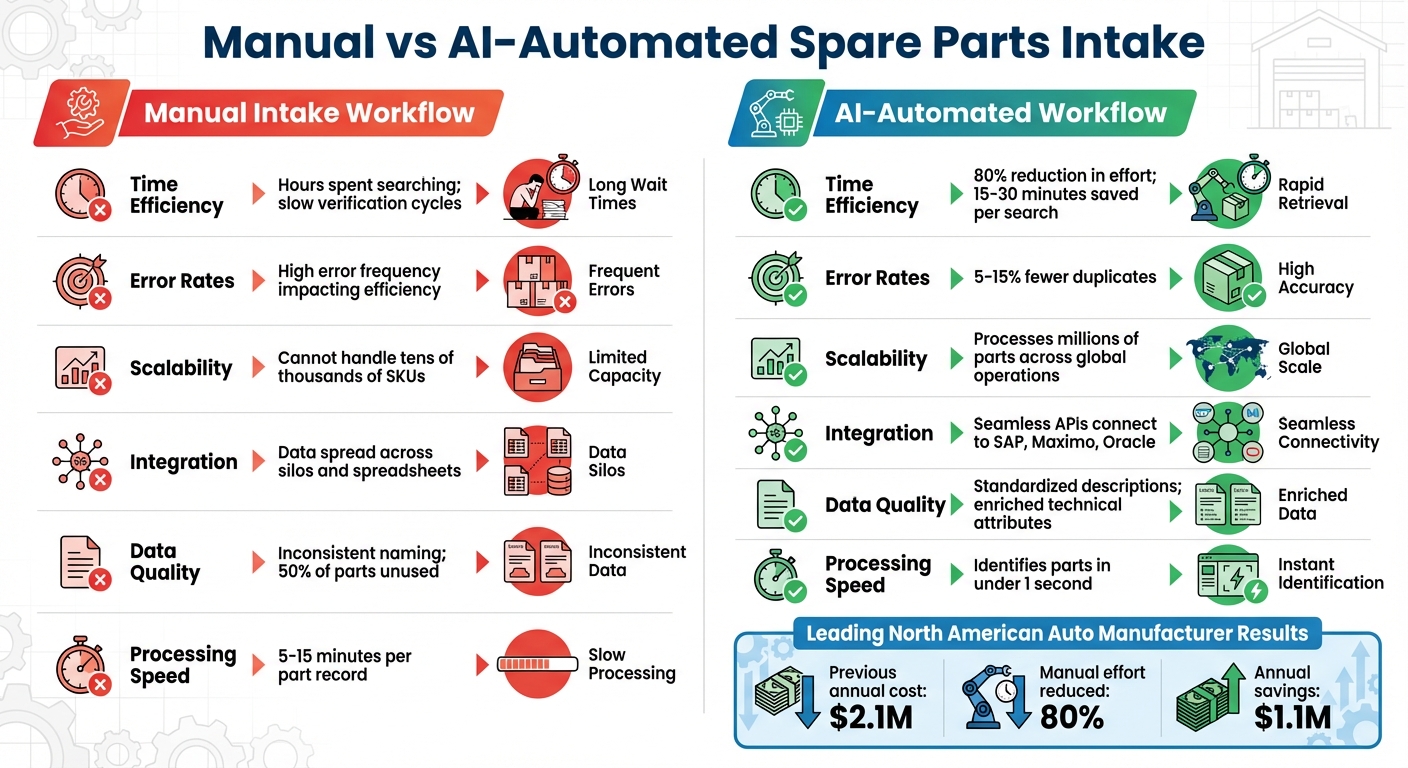
The difference between manual and AI-automated workflows becomes striking when you look at the numbers. Manual intake involves time-consuming searches, repetitive data entry, and sluggish validation steps that often create bottlenecks in operations. On the other hand, AI-powered systems can extract data from nameplates, images, and unstructured documents within seconds, slashing manual effort by 80%. This stark contrast highlights how AI can transform spare parts management.
Here’s a side-by-side look at how manual and AI-driven workflows perform across key areas:
| Feature | Manual Intake Workflow | AI-Automated Workflow |
|---|---|---|
| Time Efficiency | Hours spent searching; slow verification cycles | 80% reduction in effort; 15-30 minutes saved per search |
| Error Rates | High error frequency impacting overall efficiency | Low; 5-15% fewer duplicates |
| Scalability | Cannot handle tens of thousands of SKUs effectively | Processes millions of parts across global operations |
| Integration | Data spread across silos and spreadsheets | Seamless APIs connect to SAP, Maximo, and Oracle |
| Data Quality | Inconsistent naming; 50% of parts unused | Standardized descriptions; enriched technical attributes |
| Processing Speed | 5-15 minutes per part record | Identifies parts in under 1 second |
These numbers paint a clear picture of how AI-driven workflows bring efficiency and accuracy to spare parts intake, creating broader operational improvements.
For example, a leading North American auto manufacturer adopted AI-powered data entry agents in 2024. Before this, their manual process cost them $2.1 million annually and was riddled with human errors. By deploying AI capable of handling over 200 unique formats, they reduced manual effort by 80% and saved $1.1 million annually.
The scalability of AI is another major advantage. While manual reviews struggle with 50,000+ SKUs, AI systems can process data at enterprise scale without requiring additional staff. North America’s largest downstream oil refining company resolved $10 million in duplicate materials and uncovered $81 million in potential savings over four years by eliminating redundant purchases and consolidating suppliers.
“Poor quality data costs businesses an average of $15 million per year, and in manufacturing… a massive chunk of that stems from inaccurate or inconsistent parts and material master data.” - Manish Shewaramani, VP of Sales, Credencys
AI tools integrate seamlessly with existing platforms through pre-certified connectors, providing unified visibility without requiring disruptive system changes. This approach allows companies to achieve results within 2-4 weeks while maintaining their current ERP systems - showing how automation can revolutionize the entire intake process.
Conclusion
The seven AI-driven methods discussed in this article work together to transform spare parts management from a reactive process into a forward-thinking strategy. AI-powered nameplate extraction removes the risk of manual data entry errors, while automated image processing ensures precise and reliable product records. Add to that real-time inventory synchronization, and maintenance teams can always stay informed about available stock. When combined with automated purchase orders, predictive analytics, intelligent approval workflows, and instant market verification, this integrated approach can reduce working capital by 15% to 30% and cut emergency purchases by 20% to 40%. Together, these advancements create a foundation for ongoing AI-driven governance.
By 2026, spare parts master data will no longer be a back-office detail - it will be a strategic advantage critical to industrial success. The growing complexity of modern equipment has made manual spreadsheets and instinct-based planning obsolete. Companies relying on fragmented or inaccurate data are already losing around $15 million annually due to poor data quality.
The move from traditional batch data cleanup to continuous AI-driven governance eliminates the long waits for manual data cleansing projects. With modern AI tools integrating seamlessly via APIs, organizations can see measurable improvements in as little as 30 to 60 days. Additionally, these tools capture the expertise of retiring technicians, preserving “tribal knowledge”, while easing the workload on current staff through automated visual recognition.
With streamlined governance in place, AI-driven automation reshapes how spare parts are managed. Stocking decisions are based on failure probabilities and real-time demand rather than outdated “just in case” buffers. Instead of spending 15 to 30 minutes poring over PDF catalogs to find a part, technicians can now identify components instantly using a smartphone photo. This leads to fewer critical stockouts, less capital tied up in slow-moving inventory, and maintenance teams able to focus on keeping assets running smoothly.
In 2026, the real challenge isn’t deciding whether to adopt AI - it’s how quickly you can implement it to avoid downtime that costs thousands of dollars per minute.
FAQs
What data should we capture first for spare parts intake?
To get started, gather key identification details like part numbers, descriptions, and SKU information. Precise part numbers and consistent nameplate data are essential for avoiding duplicate entries, organizing items correctly, and simplifying inventory processes. Prioritizing this core information early on enhances data accuracy, enables automation, and improves overall workflow efficiency.
How clean do our ERP/CMMS records need to be before using AI?
Your ERP or CMMS data doesn’t have to be flawless before using AI, but it should be reasonably organized and standardized. While AI is capable of managing imperfect data - like filling in missing details or spotting duplicates - cleaner data leads to better outcomes. For example, tasks like demand forecasting or inventory optimization benefit significantly from consistent part descriptions, uniform part numbers, and standardized formatting.
In short, AI can handle messy data, but the cleaner your records, the more accurate and efficient your results will be.
What’s the fastest way to run a pilot and prove ROI?
The fastest way to test and show the ROI of improving inventory intake is by leveraging AI-powered solutions. A targeted AI pilot - like cleaning data, merging duplicate entries, or automating cataloging tasks - can cut manual work by as much as 80%, delivering noticeable cost savings in a short time. Begin with a small dataset to test the results, reduce potential risks, and create a strong argument for expanding AI use throughout your operations.